
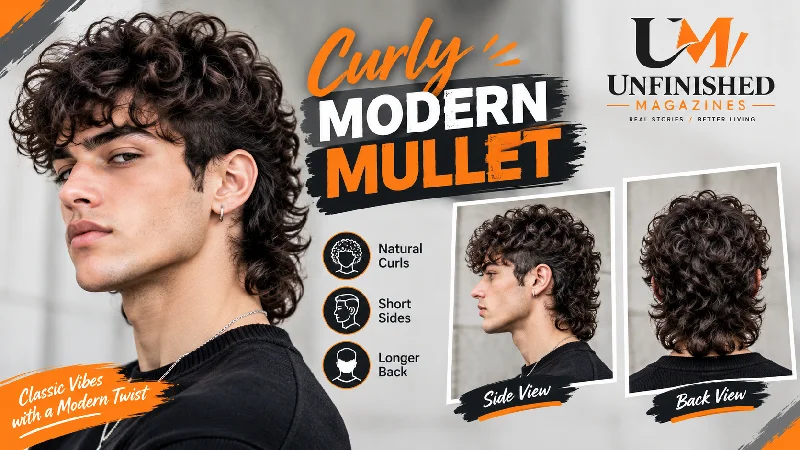
Looking for a haircut that feels modern without giving up your natural curls? A curly modern mullet could be the style you are looking for.
This updated version of the classic mullet combines shorter sides with more length and texture toward the back. Instead of hiding natural curls, the haircut uses them to create volume, movement, and personality.
The best part is that there is no single way to wear this haircut. You can choose a subtle taper, a bold fade, a shaggy layered shape, or a longer version depending on your curl pattern, hair density, face shape, and lifestyle.
What Is a Curly Modern Mullet?
A curly modern mullet is a contemporary take on the traditional mullet, designed to work with naturally curly or wavy hair.
The basic structure keeps the sides and front shorter while leaving additional length toward the back. Modern versions usually use blending, layering, tapering, or fading to create a more balanced appearance.
Unlike an old-school mullet, the modern approach doesn’t always create extreme contrast between the sides and back. Your stylist can adjust the haircut to match your natural texture.
This makes the style suitable for different curl patterns, from loose waves to defined curls and tighter textures.
Why Is the Curly Mullet So Popular?
Natural texture has become an important part of modern hairstyling. Instead of straightening or heavily controlling curly hair, many people now choose cuts that let their natural pattern become part of the style.
A curly mullet offers several advantages:
- It highlights natural curls and texture.
- The longer back creates a distinctive silhouette.
- Different fades and tapers can change the overall appearance.
- It can work with short, medium, or long hair.
- It offers both relaxed and bold styling options.
- You can personalize the haircut for different curl patterns.
However, it works best when customized rather than copied exactly from a photograph.
Specific Curly Modern Mullet Style Variations
1. Curly Wolf Cut Mullet
The curly wolf cut mullet combines the layered volume of a wolf cut with the recognizable shape of a mullet.
It usually features plenty of movement around the crown and longer textured sections toward the back. This option works particularly well for people with medium or thick curls.
Maintenance: Refresh curls between washes and ask your stylist to preserve the layers. A shape-up every 6–10 weeks can help maintain the overall structure.
2. Curly Taper Mullet
A curly taper mullet keeps the sides and neckline gradually shorter instead of creating a dramatic fade.
This creates a cleaner look while keeping the curls prominent on top and at the back.
Maintenance: The taper may need a touch-up every 3–5 weeks. Use lightweight styling products around the tapered sections.
3. Curly Fade Mullet
A curly fade mullet creates a stronger contrast between the short sides and longer curly top and back.
Choose a low, mid, or high fade depending on how dramatic you want the haircut to look.
Maintenance: Faded sides generally require more frequent visits. A 2–4 week touch-up can help keep the fade sharp.
4. Short Curly Mullet
A short curly mullet keeps the overall length controlled while maintaining the characteristic longer back section.
It is a practical choice if you like the mullet shape but do not want a long hairstyle.
Maintenance: Trim every 4–6 weeks. A small amount of curl cream can help maintain definition without weighing the hair down.
5. Long Curly Mullet
A long curly mullet keeps more length at the back, creating a stronger, more dramatic silhouette.
This version can look particularly striking when the curls have enough density to maintain volume through the longer sections.
Maintenance: Shape the ends approximately every 8–12 weeks. Regular conditioning is especially important because longer curls can become dry.
6. Curly Shag Mullet
A curly shag mullet combines shag-inspired layers with the recognizable mullet shape.
The result is usually fuller at the crown, with loose, textured layers throughout. It is a good choice for someone who prefers a relaxed, intentionally messy look.
Maintenance: Maintain the layers every 6–10 weeks. Use lightweight products that enhance texture without making the hair heavy.
7. Curly Mohawk Mullet
The curly mohawk mullet emphasizes volume through the center while keeping the sides considerably shorter.
This adventurous variation creates a strong contrast between the sides, top, and back.
Maintenance: Short sides may require trimming every 2–4 weeks. Keep the central curls moisturized and avoid brushing them when they are dry.
8. Curly Mullet With an Undercut
A curly mullet with an undercut creates a noticeable separation between the longer top and back and the shorter sides.
Because the sides are cut significantly shorter, the curls become the main focus.
Maintenance: The undercut usually needs a trim every 3–5 weeks. Condition the longer sections regularly to maintain softness and definition.
9. Low-Fade Curly Mullet
A low fade curly mullet keeps the fade close to the lower part of the sides. This leaves more natural curl visible around the temples and upper sides.
It balances a traditional curly mullet with a more dramatic fade.
Maintenance: A 3–5 week touch-up can keep the fade clean. Use a lightweight leave-in conditioner or curl cream when your curls need extra moisture.
10. Curly Mullet With Bangs
Bangs add texture around the forehead while keeping length toward the back.
The fringe can be short and defined or longer and allowed to fall naturally.
Maintenance: Watch fringe length because curly hair can shrink as it dries. Trim the bangs when they start to interfere with the desired shape.
How to Choose the Right Curly Mullet
The best variation depends on your natural hair and how much maintenance you want.
Loose waves: A curly shag or wolf-cut-inspired mullet can add movement while keeping the overall shape soft and relaxed.
Defined curls: A taper or low fade creates a clean outline while keeping your curls as the main feature.
Thick hair: Strategic layering can remove excess weight while preserving natural volume and movement.
Tight curls: A carefully shaped short or tapered mullet can emphasize your natural texture while keeping the overall shape controlled.
Long curls: Keeping extra length at the back creates a dramatic silhouette without sacrificing your natural curl pattern.
Low-maintenance style: A softer taper with moderate length is usually easier to manage than a sharp fade or undercut.
Bold appearance: A high fade, undercut, or mohawk-inspired variation can create stronger contrast and give the haircut a more noticeable edge.
How to Style a Curly Modern Mullet
Good styling starts with properly hydrated hair.
After washing, gently remove excess water and apply a suitable leave-in conditioner or curl cream. Distribute the product through damp hair using your fingers or a wide-tooth comb.
Avoid aggressive brushing because it can separate curls and create frizz.
Then let your hair air-dry or use a diffuser on a low or moderate heat setting. Once the curls are dry, avoid touching them repeatedly.
For stronger hold, a lightweight gel can help define the curls while preserving movement.
Maintenance Tips for Curly Mullet Hair
Different versions require different levels of maintenance. Fades and undercuts generally need more frequent touch-ups than longer, softer styles.
| Curly Mullet Style | General Shape-Up |
| Curly Fade Mullet | Every 2–4 weeks |
| Curly Mohawk Mullet | Every 2–4 weeks |
| Curly Taper Mullet | Every 3–5 weeks |
| Curly Mullet With Undercut | Every 3–5 weeks |
| Low-Fade Curly Mullet | Every 3–5 weeks |
| Short Curly Mullet | Every 4–6 weeks |
| Curly Wolf Cut Mullet | Every 6–10 weeks |
| Curly Shag Mullet | Every 6–10 weeks |
| Long Curly Mullet | Every 8–12 weeks |
| Curly Mullet With Bangs | As needed |
These are general guidelines rather than strict rules. Hair growth rate, curl shrinkage, density, and personal preferences can change the ideal schedule.
Keep Curly Hair Moisturized
Curly hair can dry out more easily because natural oils don’t always travel evenly along the bends of the hair.
Use a conditioner suited to your hair type, and consider a lightweight leave-in if your curls need extra moisture.
Avoid too many heavy products, as they can make curls look flat or greasy.
Detangle Gently
Use your fingers or a wide-tooth comb to detangle damp, conditioned hair.
Start from the ends and gradually work toward the roots. This approach can reduce unnecessary pulling and breakage.
Avoid aggressively brushing dry curls unless your hairstyle specifically requires it.
Avoid Excessive Heat
Frequent high-heat styling can contribute to dryness and damage.
If you use a diffuser, choose a low or moderate heat setting. Keep the diffuser moving instead of concentrating heat on one area for an extended period.
Protect Your Curls While Sleeping
Friction from bedding can disturb the curl pattern and contribute to frizz.
A smooth pillowcase or a loose protective hairstyle can help reduce friction. Avoid tying your hair too tightly, as excessive tension can put unnecessary stress on it.
Common Curly Mullet Mistakes
Copying Someone Else’s Haircut Exactly
A reference photo helps, but your hair may have a different curl pattern, density, and shrinkage level.
Ask your stylist to adapt the shape to your own hair.
Removing Too Much Weight
Over-layering thick curls can sometimes make the hair expand in unwanted areas. The stylist should remove weight strategically while maintaining enough fullness.
Ignoring Curl Shrinkage
Curly hair can appear considerably shorter after it dries. A stylist should consider shrinkage before deciding how much length to remove.
Using Too Much Product
More product does not always mean better curls. Heavy styling products can make the hair feel greasy or reduce natural volume.
Start with a small amount and add more only when necessary.
Neglecting the Neckline and Sides
A curly mullet can lose its shape as the shorter sections grow out. Regular cleanup around the neckline, temples, or fade can make a significant difference.
Is a Curly Mullet Suitable for Everyone?
A curly mullet can work for many different people, but the best version depends on individual characteristics and styling preferences.
Your curl pattern, hair density, face shape, and desired maintenance level all influence the final result.
If you prefer a subtle look, a soft taper and moderate back length may be right for you. If you want something more noticeable, a fade or undercut can create a stronger contrast.
The most important step is finding a stylist who understands curly hair and communicating clearly about the result you want.
What to Tell Your Barber or Stylist
Before your appointment, save two or three reference photos showing the type of curly mullet you like.
Then explain:
- How much length you want at the back
- How short you want the sides
- Whether you prefer a fade, taper, or undercut
- How much volume you want on top
- Whether you want your curls defined or naturally textured
- How much time you normally spend styling your hair
Also tell your stylist how you normally wear your hair. A haircut designed for natural curls should account for how the hair behaves when it dries.
Frequently Asked Questions
Is mullet a queer haircut?
No. A mullet is not exclusively a queer haircut. People with different genders, identities, and backgrounds wear mullets.
Some LGBTQ+ communities have embraced creative and unconventional hairstyles, but a haircut itself does not determine someone’s sexual orientation or gender identity.
What is the 401k mullet?
The “401(k) mullet” is a humorous financial expression that uses the mullet hairstyle as a metaphor. It generally describes having a more conservative approach in one part of a retirement strategy and a more aggressive approach in another.
It is a financial phrase, not a specific haircut.
What is the Gen Z mullet?
The Gen Z mullet is a modern interpretation of the classic mullet. It often features shorter sides, textured layers, and a longer back.
The exact style varies because the term covers several contemporary interpretations. You can also adapt it for straight, wavy, and curly hair.
Is a mullet suitable for curly hair?
Yes. Curly hair can work particularly well with a mullet because natural curls add volume, texture, and movement.
Customize the haircut to your curl pattern, density, shrinkage, and preferred length. A stylist experienced with curly hair can adjust the layers and shape to create a balanced result.
How often should I cut a curly mullet?
The answer depends on the style. A fade or undercut may need attention every 2–4 weeks, while a longer or softer curly mullet can often go 6–12 weeks between major shape adjustments.
Can thick curly hair have a mullet?
Yes. Thick curly hair can create excellent volume for a mullet. However, the haircut should remove weight carefully. Too much layering can make thick curls expand unpredictably.
How do I reduce frizz in a curly mullet?
Keep your curls well moisturized, avoid excessive brushing, and use styling products suited to your hair type. Applying products while the hair is damp can also help encourage consistent curl definition.
Final Thoughts
The curly modern mullet is a flexible haircut that allows natural curls to become part of the overall design. From a subtle taper to a dramatic fade, wolf cut, shag, or long layered version, there are plenty of ways to personalize the style.
The key is not simply choosing a trendy reference photo. Your curl pattern, hair density, shrinkage, lifestyle, and preferred maintenance level should all influence the final haircut.
If you are considering this style, talk with a stylist who understands curly hair and bring a few reference photos to your appointment. With the right shape and a simple maintenance routine, a curly mullet can look distinctive, natural, and easy to maintain.
Looking forward to getting more information.
One thought on “Curly Modern Mullet Styles, Styling Tips and Maintenance”